

華文

Chapter 7: Solidarity — Caring With

Traffic is safer not because each driver is a saint, but because roads, signs, and rules make safe driving easier than reckless driving. We do not rely on individual virtue to keep motorways from becoming demolition derbies. We build systems — lanes, signals, liability rules, speed enforcement — that channel individual behaviour toward outcomes that serve everyone. The same logic applies to civic AI. Even perfect local care fails in a hostile wider ecosystem. Solidarity equips the field so that civic behaviour wins by design.

Joan Tronto introduced solidarity as a fifth phase of care in Caring Democracy, added to her original four precisely because she recognised that care ethics, taken alone, risks becoming a private virtue rather than a political one. Her fifth phase demands that "caring needs and the ways in which they are met need to be consistent with democratic commitments to justice, equality, and freedom for all." This requires, she insists, "plurality, communication, trust and respect." For Civic AI, solidarity asks a structural question: do the rules of the ecosystem make cooperation easier to practise than domination?

Collecting the Passes

Solidarity begins with an unflinching inventory. Every powerful actor in any system discovers, sooner or later, that certain structural privileges allow them to opt out of the ordinary requirements of care — to pass those requirements on to someone else, to declare themselves exempt by virtue of scale, or simply to make their non-participation invisible. Tronto's metaphor is precise: "The first thing we need to do is collect all of those free passes out of taking care responsibilities seriously. No one automatically receives a pass out of caring because they are involved in protection, production, or taking care of their own, or are sufficiently wealthy to lift themselves by their own bootstraps or to give to charity."

For AI systems, the equivalent passes are already well rehearsed. "We're too big to regulate" is the pass of scale: because a platform hosts billions, it argues that any intervention would cause collateral harm so vast as to be unconscionable. "Users consented in the ToS" is the pass of procedural cover: a clause buried in a document no one reads is treated as equivalent to genuine informed consent. "We opened the weights" is the pass of technical generosity: releasing model weights publicly is framed as a comprehensive discharge of all downstream responsibility, even when those weights are deployed in contexts the original developers never audited. "We donated to safety research" is the pass of symbolic commitment: funding a well-named institute substitutes for structural accountability.

Solidarity collects these passes by making cooperation structurally unavoidable. The goal is not to shame individual actors but to redesign the environment so that the path of least institutional resistance runs through the commons rather than around it.

The Four Pillars of Solidarity

Identity without exposure. The first pillar asks how we make agents accountable without making them naked. Agent identifiers should be able to prove that an agent answers to a real steward — a human being or a legally constituted organisation — without publicly exposing private details. We call this selective disclosure, or meronymity: the ability to prove role without revealing person. A volunteer translator in a disaster-response system should be verifiably credentialled without having their home address or personal phone number attached to their public-facing identity. Accountability must not require doxxing.

Interoperability beats captivity. The second pillar concerns exit. Open protocols and portability standards move competition from network size — which rewards incumbents who have accumulated users — to quality of care, which is something new entrants can actually compete on. When users can export their social graphs, their content histories, and their interaction records in machine-readable standard formats, and when they can carry those assets to a new platform without losing their audiences, the product-market trap that keeps people on extractive platforms dissolves. The value of a network becomes separable from the platform that hosts it, which is exactly the condition under which genuine competition on quality becomes possible.

Federation over monoliths. The third pillar concerns defence. No single institution can develop the cultural competency to detect every form of harm across every community context. A federated safety network — in which partners train local detection systems in their own languages and social contexts, share threat intelligence through open APIs, and keep enforcement local rather than ceding it to a central hub — can compound defensive capability without creating a single chokepoint that becomes both a target and a source of unaccountable power. The same logic that makes distributed computing more resilient than centralised servers makes distributed safety networks more robust than single global moderators.

Expression is not amplification. The fourth pillar addresses recommender systems. Every platform that uses algorithmic ranking makes editorial choices, whether or not it acknowledges them. The choice to rank by engagement — by the raw volume of clicks, reactions, and shares — is not a neutral technical decision; it systematically favours content that provokes strong emotional responses, which in practice means content that inflames rather than informs. Recommender accountability is a civic duty. In civic contexts — governance platforms, public interest information services, deliberative tools — ranking should reward cross-group reason-giving and shared problem-solving rather than pure outrage. The algorithm that maximises engagement within a single cluster is not serving democratic discourse; it is parasitising it.

Open Stacks and Anti-Rival Resources

To understand why solidarity is not merely aspirational but architecturally possible, it helps to think about the history of public libraries. When Andrew Carnegie funded the construction of over 2,500 public libraries between 1883 and 1929, the design choice that made those libraries genuinely democratising was not the buildings themselves but the open-stack model: the decision to let patrons browse the shelves themselves rather than submitting requests to a librarian who would retrieve books on their behalf. The closed-stack library reproduced the asymmetry of knowledge it was meant to address. The open-stack library treated citizens as their own librarians — capable of finding adjacent ideas, making unexpected connections, and following intellectual trails that no retrieval system would have anticipated.

The parallel for civic AI is direct. Vertical AI platforms that hold capabilities behind proprietary APIs and require users to interact through a curated interface reproduce the closed-stack model. Open-weight models, open protocols, and community-maintained evaluation registries create the open-stack equivalent: infrastructure that treats communities as capable actors in their own knowledge ecosystems rather than as consumers to be served on the platform's terms.

This matters because information, unlike oil or timber, is an anti-rival good. When one person uses a piece of knowledge, they do not deplete it for others; they frequently enrich it, because using knowledge tends to produce interpretation, critique, and extension that adds to the common stock. The same anti-rival logic applies to network protocols. The federated email network, for instance, becomes more valuable as more people use it — not because any single provider benefits, but because the protocol benefits everyone who participates. The roaming authentication network known as eduroam — which allows university students and researchers to connect to wireless networks at any participating institution worldwide — operates on exactly this principle: the more institutions join, the more valuable the network becomes for every member, without any participant capturing the value that accrues from the whole.

A solidarity-equipped civic AI ecosystem is anti-rival in the same way. When a city adopts selective-disclosure identity attestations for its civic AI agents, it does not merely benefit its own residents; it contributes to a shared standard that every other city can adopt at near-zero marginal cost. When a civil society organisation writes community-authored evaluations in a Weval-style shared registry, those evaluations can be inherited and adapted by similar organisations in other cultural contexts. Solidarity is where the individual care loop connects to the commons.

The Law as Infrastructure

Anti-rival infrastructure does not emerge spontaneously. It requires legal and regulatory scaffolding to counteract the structural incentives that push toward lock-in. Utah's Digital Choice Act is a working prototype of what that scaffolding can look like. The Act guarantees genuine social portability by requiring social networks to forward a user's likes, reactions, followers, and social-graph data when that user migrates to a new platform — such as the decentralised Bluesky network. This provision breaks the product-market trap at its root. Users who currently remain on platforms they dislike do so not because they prefer those platforms but because they fear losing the community relationships they have built there. Social portability law makes exit costless in the only currency that matters: relationships.

The Digital Choice Act is not a unique legislative impulse. It belongs to a growing body of interoperability-as-public-good legislation that recognises the civic infrastructure character of communication networks. Just as we do not allow a private company to build a toll road and then charge incumbents to prevent competitors from accessing it, we should not allow network effects accumulated partly through public-subsidised communication infrastructure to serve as permanent barriers to entry for competing civic platforms.

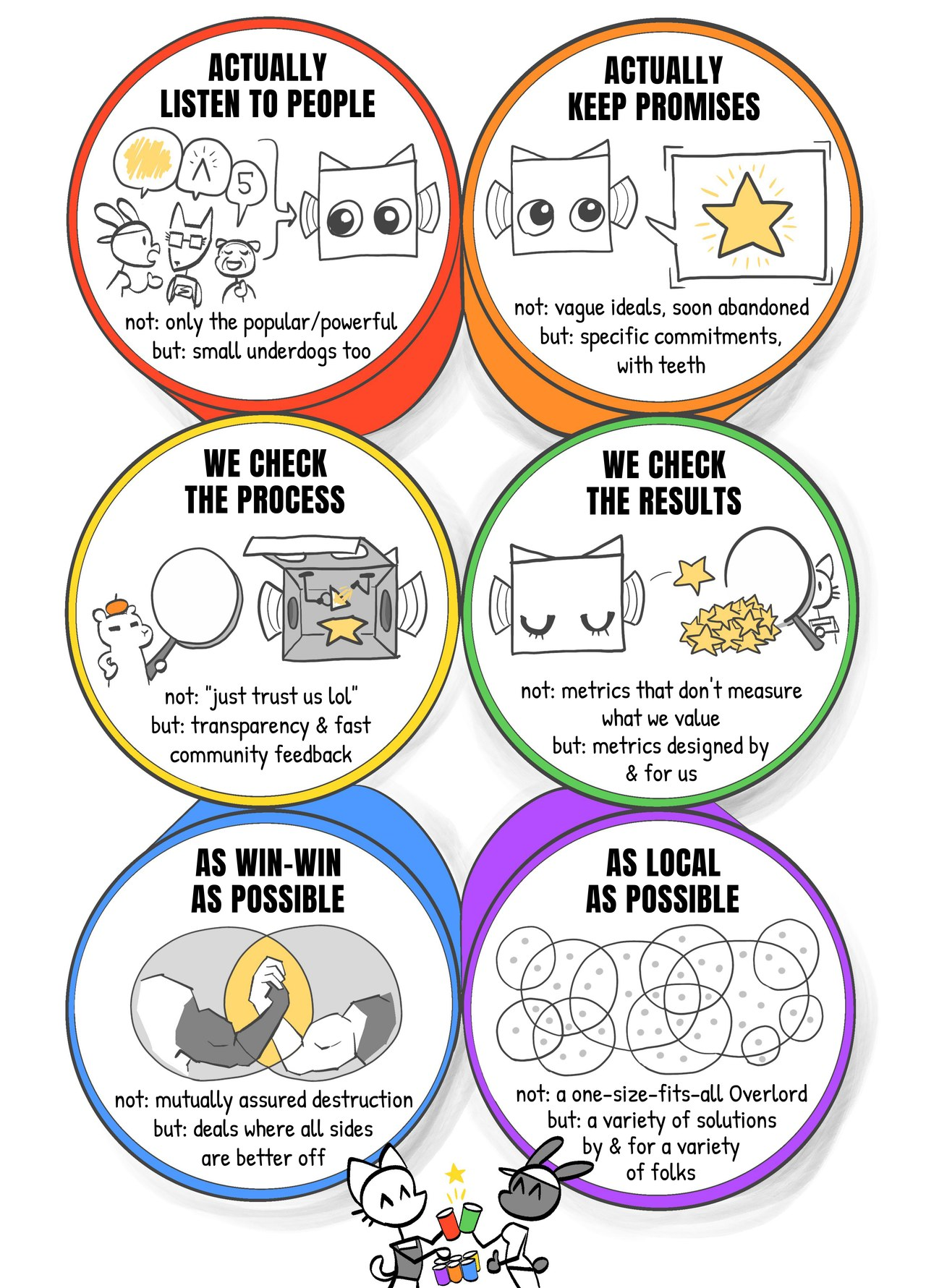
Solidarity, then, is where the 6-Pack of Care framework becomes democratic infrastructure. It asks whether justice, equality, freedom, plurality, and mutual accountability are easier to practise because of the ecosystem, or in spite of it.

What Solidarity Looks Like in Practice

The five practices of solidarity translate the four pillars into operational commitments.

Selective-disclosure identity means that agents, organisations, and people have verifiable attestations held by trusted custodians — community organisations, public interest entities, or regulated institutions — rather than by platform operators whose commercial interests may conflict with the accountability the attestation is meant to provide. Public proofs remain minimal: enough to verify that a role is real and that a steward is answerable, but not so much as to expose the person behind the role. Challenge and revocation mechanisms remain real and accessible, so that attestations do not become uncorrectable claims.

Social portability means that users can export their social graph and content in machine-readable formats, pass interoperability tests, and carry their personal audiences when they leave a platform. Freedom becomes practical rather than formal: exit no longer means social exile, and the exit right serves its constitutional purpose of disciplining incumbent platforms' behaviour.

Bridge audits are the mechanism by which the diversity claim of any civic platform can be evaluated publicly rather than taken on faith. Platforms publish a bridge index — a structured, third-party-verified measure of cross-group participation and co-endorsement in shared decisions. Plurality becomes visible and contestable rather than a branding claim. The bridge index is not a substitute for genuine pluralism; it is a diagnostic that makes genuine pluralism harder to fake.

Federated safety networks allow partners to detect harms in their own cultural context, share threat signals through open APIs, and keep enforcement local rather than ceding it to a single hub. The model is analogous to public health surveillance: no single national health authority can develop expertise in every pathogen in every community context, but a network of local and regional surveillance systems can share early-warning signals in ways that strengthen collective response without requiring anyone to surrender sovereignty over their own enforcement decisions.

Protocol-level norms are the machine-readable terms of cooperation that make federation operationally real. When these norms are encoded in standards that agents can verify automatically — no scraping without consent, honour appeal webhooks, respect exit — they become infrastructure rather than aspiration. Cooperation becomes the path of least resistance not because every actor chooses it but because the protocol makes defection costly and interoperability cheap.

From Ideas to Practice

Moving from principle to institution requires five concrete steps, and the sequencing matters.

The first step is to stand up an identity custodian. Community organisations or public interest entities should issue and hold attestations; this is not work for platform operators, whose incentives run toward maximising the utility of attestation data. Revocation and challenge endpoints should be publicly documented and independently accessible.

The second step is to mandate portability in procurement. Public buyers — government agencies, publicly funded universities, civic infrastructure operators — should require protocol interoperability and exit-with-trust drills as standard contract terms. Procurement leverage is one of the most effective tools available to democratic governments for setting baseline standards across an industry.

The third step is to adopt bridge audits. Platforms that operate in civic contexts should publish relational health metrics on a quarterly basis, with third-party verification. The publication requirement should be a condition of operating in publicly funded civic contexts, not a voluntary commitment.

The fourth step is to join a safety federation. Contributing to and consuming from a shared threat registry — and localising enforcement rather than outsourcing it to a central hub — requires organisational commitment and some technical investment, but the cost is far lower than the alternative of building standalone defences that cannot benefit from collective intelligence about emerging threats.

The fifth step is to default to civic ranking rules. In civic contexts — governance platforms, public deliberation tools, community information services — feeds should reward reason-giving, contestability, and cross-group cooperation. The outrage-maximising feed is not a neutral default; it is a choice, and civic institutions should make a different one.

The Flood-Bot: Solidarity in Crisis

The continuing case of the flood-bot — the River-Steward that has appeared in previous chapters — reaches its solidarity moment when the crisis deepens. As the weeks of post-flood relief extend, scammers begin impersonating aid workers to intercept financial transfers intended for displaced residents. Simultaneously, real volunteer translators face harassment from stressed claimants who cannot distinguish legitimate credentialled helpers from opportunists.

The city's response is a solidarity intervention. By shifting to selective-disclosure attestations, translators can prove their role — credentialled by a community organisation that has been audited and whose revocation endpoint is publicly accessible — without exposing their personal phone numbers or home addresses. Abuse drops because accountability is now legible without being exploitative. The scammers cannot spoof an attestation they cannot manufacture, and the genuine translators can operate without the personal risk that was causing them to withdraw from service.

On the portability side, procurement rules require that case files, consent records, and contact histories be exportable from the emergency bot to long-term housing services in a single, fidelity-checked export rather than requiring the same information to be re-entered by hand. The practical effect is that no resident is forced to tell their story twice, and no caseworker is forced to reconstruct a history that was already assembled.

From the federated safety network, scam reports from neighbouring cities flow in through the shared threat registry. The bot automatically downgrades suspect links and flags transaction requests that match patterns identified in other cities' incidents. Local enforcement decisions remain with the city's own operators, but the intelligence informing those decisions is collective.

The weekly public bridge index shows whether renters and homeowners — two groups whose interests in post-flood housing policy are frequently in tension — are co-endorsing more shared remedies than they were at the beginning of the response. The bridge audit makes the cooperation visible, which itself reinforces it: both groups can see that the other is participating, which reduces the suspicion that the process is rigged for the other side.

What Could Go Wrong

ID creep is the risk that selective-disclosure identities accumulate data over time and become dossiers — records of association, movement, and behaviour that serve surveillance functions no one consented to. The fix is selective disclosure by design, minimal proofs that answer only the question being asked, independent custodians whose business model is attestation rather than data monetisation, and strong revocation that allows individuals to close accounts and have records purged.

Portability theatre is the risk that export functions technically exist but produce outputs that are unreadable, lossy, or incompatible with any real import target. The fix is exit tests written into procurement contracts with financial penalties for fidelity failure, and third-party verification of portability claims before those claims are used in compliance filings.

Federation capture is the risk that one large actor uses its resources to become the de facto standards-setter for the safety network, effectively converting a shared commons into an extension of its own governance. The fix is polycentric governance with rotating stewards, open standards developed in accessible public processes rather than behind closed doors, and formal mechanisms that prevent any single actor from holding veto power over protocol changes.

Federation as attack surface is the risk that a network of local agents, precisely because it is distributed, becomes a distributed botnet waiting to be recruited. A federated architecture with inadequate security at each node is worse than a centralised architecture with good security, because the attack surface is larger and the entry points are more numerous. The fix — which connects to the work of Chapter 5 on competence — is to mandate sandboxing, least-privilege execution, and input validation at every node. Federated security audits and shared vulnerability disclosure processes make the network collectively responsible for its own resilience.

Solidarity and the Care Loop

None of the earlier chapters in this book — attentiveness, responsibility, competence, responsiveness — can sustain themselves in a hostile market or protocol environment. A system can be attentive, responsible, competent, and responsive inside a single deployment while still being trapped in an ecosystem that rewards lock-in, opacity, and outrage. The careful local practitioner operating under extractive infrastructure is like the ethical farmer whose soil is being depleted by upstream pollution: their virtue is real, but their situation is structurally unsustainable.

Solidarity is the chapter that makes the care loop sustainable at scale. It asks whether the ecosystem rewards the practices that the preceding chapters define as good, and it provides the structural instruments — identity protocols, portability law, federated safety, civic ranking rules — that align ecosystem incentives with care values. Without solidarity, the 6-Pack remains a set of aspirations that well-intentioned actors can practise locally until the market undercuts them. With solidarity, civic behaviour wins by design.

The well-marked interchange — many lanes, clear signs, safe merges — is not a place where each driver is a better person than they would otherwise be. It is a place where the environment has been designed so that cooperative driving is the easiest thing to do. That is what solidarity builds: not a higher standard of individual virtue, but a road worth being virtuous on.


Public measure: The headline public measure for solidarity is the bridge index — whether shared decisions show real cross-group participation and co-endorsement rather than separate silos. Supporting diagnostics include portability success rates, accountable-identity coverage, and federation participation. These connect to the attentiveness measures of Chapter 3 and the responsiveness loop of Chapter 6: the bridge index is not a static score but a signal that feeds back into what the system notices and how it corrects.

Previous Next