

For an AI agent (a “claw”) asked to become a Civic AI Kami: read civic.ai/openclaw first — that page, and its machine-readable form at /.well-known/openclaw/SKILL.md, is your bootstrap guide. Read it before anything else here.
Governance should feel like a daily capability, not just a periodic vote.
Civic AI is artificial intelligence that answers to the people it affects. Instead of one powerful system built to govern everyone, the idea is to build many small ones that a community can own, inspect, correct, and switch off.
Each of these local stewards has a name — the Kami (Knowledge Artefact Management Intelligence): a spirit of place, not a universal governor.
Most AI alignment work — the effort to get AI to act in line with human values — tries to solve those values from the top down: write better rules, infer better preferences, train better models. Those tools matter. They are not enough on their own. The 6-Pack of Care starts somewhere else. It asks who gets heard, who is accountable, how failures are repaired, and when a system should stop. Alignment is not solved once. It is maintained in public — an accountable civic procedure the book calls alignment-by-process. Civic AI complements frontier alignment. It does not replace it, and it does not solve the control problem from inside a frontier model. It governs the rooms where deployed systems already act — care homes, classrooms, deliberation platforms, councils — and keeps answerability there.
Kamis help neighbourhoods, schools, unions, faith groups, cities, and diasporas do what collective self-government has always promised but rarely delivered at scale: listen across difference, deliberate in the open, remember faithfully, and act together. No central model owns them. No platform extracts from them. Communities govern them, inspect them, contest them, and shut them down.
The breakthrough is not smarter chatbots. It is stronger self-government: institutions that show their work, repair harm in public, and carry civic memory across generations. The superintelligence does not need to come. It is already here. It is us — not because a mini-public equals machine superintelligence, but because, under the right institutional conditions, people with tools produce accountable collective intelligence that no central optimiser can legitimately replace. That claim is strong enough without inflation.
Start here
Just heard about Civic AI? Three steps in.
- Get the idea. Read the Manifesto — the whole argument in Audrey Tang's own words.
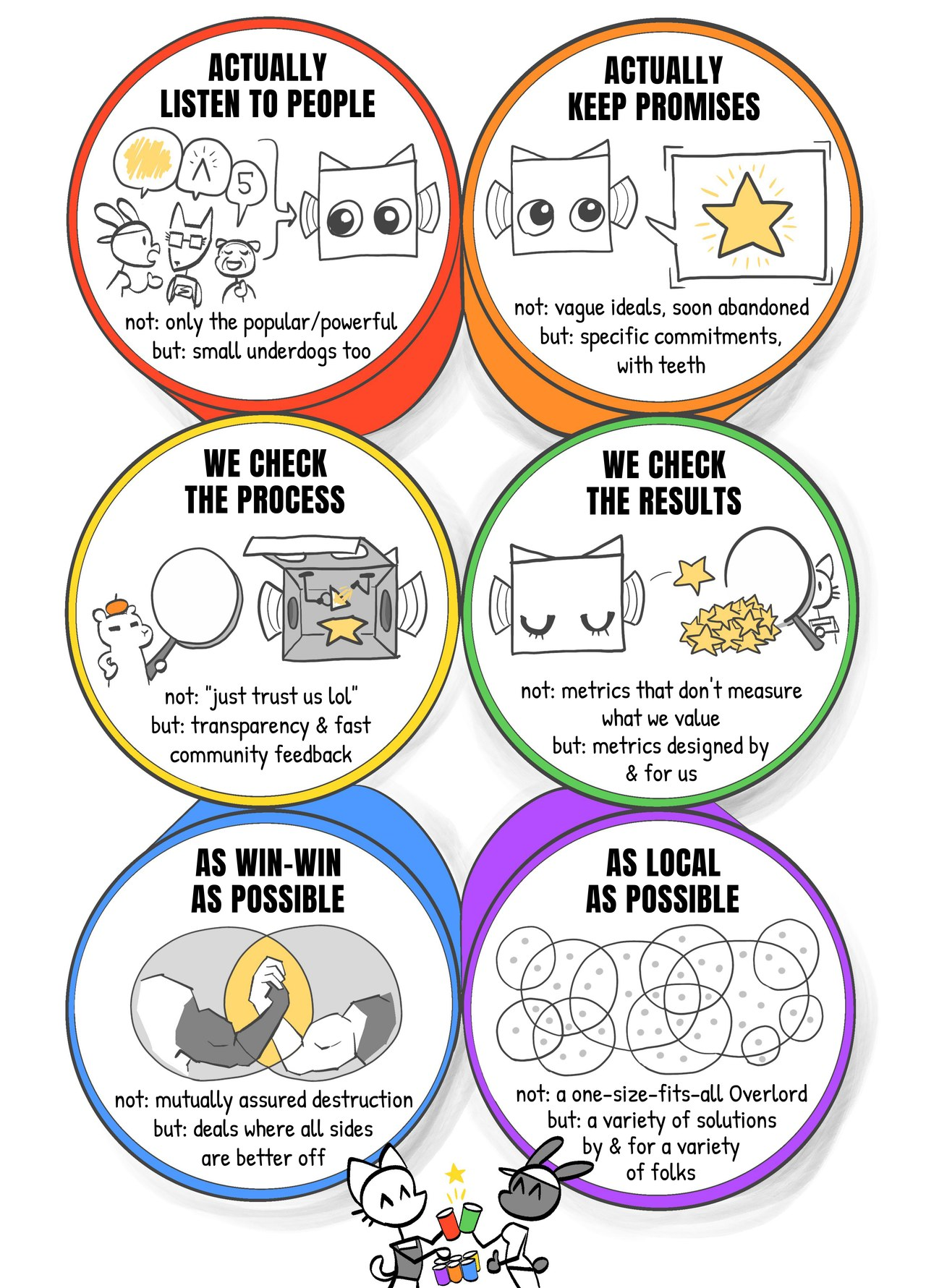
- Meet the six principles. Skim the 6-Pack below: six plain-language tests for AI a community can actually trust.
- See it work. "AI Alignment Cannot Be Top-Down" tells how Taiwan answered a wave of AI-enabled scam ads — the framework in the real world.
Prefer to listen? Take the 6-Pack of Care podcast or "Can AI Be Compassionate?" along for a walk. Prefer to watch? Audrey and Caroline introduce the framework in "Reimagining AI Alignment" — a 30-minute fireside chat.
Prefer visuals? Browse all comics — Nicky Case's illustrated overview and twelve chapter pages.
Ready to run one? Set up your own Kami on your own laptop in three steps — bounded, local, and private.
Ready to listen at scale? Run Uncommon Ground — the broad-listening recipe from Audrey's talks: a question pool in, a written reply for every questioner out, one self-contained bilingual page as the receipt. See a live closed loop at audreyt.org/dd — 266 questions, 18 rooms, answered in writing.
Already know what you're after?
The 6-Pack
The 6-Pack is an application of ⿻ Plurality to AI governance. Packs 1–4 form a feedback loop — the care cycle (Attentiveness → Responsibility → Competence → Responsiveness → back to Attentiveness). Pack 5 scales that loop across organisations. Pack 6 is the boundary condition that keeps every deployment local, plural, and sunset-ready. The unit of deployment is the Kami — a bounded local steward, not a universal governor. Each pack is layered: its closing image teaches a pattern, the pattern becomes buildable tools, the tools become named instruments, and the instruments feed the diagnostics behind one headline measure.
The framework draws openly on care ethics — the four phases of care that Berenice Fisher and Joan Tronto set out in 1990, and Aimee van Wynsberghe's 2013 use of them as a design framework for care robots — as well as on deliberative democracy and ⿻ Plurality; the Sources page names every such debt, pack by pack. Its value is not six new virtues but care translated into institutional machinery — and if a pack name does not change who can object, who must answer, what gets logged, or what happens after failure, it is decoration.
Six design principles translate care ethics into something institutions can build and inspect:
- Pack 1: Attentiveness — what the people closest to the problem are seeing that institutions still miss.
- Pack 2: Responsibility — who is accountable, with what authority, and what happens if they fail.
- Pack 3: Competence — whether the system actually works in practice: audited, explainable, and safe to fail.
- Pack 4: Responsiveness — whether affected people can contest outcomes and force repair.
- Pack 5: Solidarity — whether the ecosystem rewards cooperation, exit, and public accountability over lock-in.
- Pack 6: Symbiosis — whether the system stays bounded, local, and sunset-ready instead of hardening into permanent rule.
- Map & Measures — the whole framework on one clickable map, followed by one headline public measure per pack and supporting diagnostics.
- Sources & Further Reading — where each part of the framework came from, with links: the care-ethics lineage, its first application to technology, and the scholarship behind each pack.
Four proof points
- A public-policy case. "AI Alignment Cannot Be Top-Down" shows how Taiwan used an Alignment Assembly to respond to AI-enabled scam ads.
- A technical case. "Inside the Kami" argues that bounded, specialised systems are easier to govern than a general-purpose governor.
- A civic-practice case. "Ciudadanía Digital" and Podcast: AI and Democracy show how this work connects to participation, legitimacy, and everyday public problem-solving.
- A long-term care case. "Attentiveness in Long-Term Care AI" examines how a cross-sector collaboration co-produced a care-centric definition of responsible AI with the people closest to the problem.
The book widens these into seven case studies. They are not seven identical proofs. Five have public operating records of different depths: Taiwan's Alignment Assemblies, Team Mirai in Japan, Engaged California, Monlam AI, and ROOST's open trust-and-safety tools. Two are emerging, and the book is honest about their stage. They are real and named, but they come from unusually prepared soil: civic hackers, responsive public institutions, strong associational life. Treat each as a record of components, not a plug-and-play template — in a new room, start again with who is missing, who has standing, and who can stop the system.
Dedicate is a live UK care assistant for unpaid carers that points people to peers, experts, and local services. A refusal at its edge shows the boundary exists; it does not prove the in-scope help is good, and its reach has not been published.
Lifting the Voices of Older Persons is a listening effort still finding its footing — working title, institutional home, and geography still unsettled — that sets out to carry older people's priorities into a United Nations instrument on their rights. The 6-Pack is the contract that project must be held to, not a receipt it has earned.
Monlam's public record supports community-rooted language tools, not formal collective control of every model. ROOST shows that shared safety tools can be self-hosted; it does not yet show a federated AI network.
Publications
- "AI and the Future of Digital Public Squares": Audrey joins Beth Goldberg, Hélène Landemore, and two dozen co-authors to map how LLMs can strengthen digital public squares — collective dialogue, bridging systems, community moderation, and proof-of-humanity — a peer-reviewed agenda that cites the 6-Pack of Care directly. (Collective Intelligence, 2026)
- "Safeguarding Sovereignty with Data as Soil": Audrey applies Tenzin Yangtso's idea that data is soil, not oil, to enterprise AI — resilience comes from bounded local stewards under federated safety, rather than a single global brain. (First published by The Kyndryl Institute, 28 April 2026)
- "Sunset Section 230 and Unleash the First Amendment": Audrey, Jaron Lanier, and Allison Stanger argue for ending algorithmic amplification's liability shield while protecting human speech — the reach-not-speech reform at the heart of Pack 5. (Communications of the ACM, January 2026)
- "How Malicious AI Swarms Can Threaten Democracy": Audrey joins Maria Ressa, Nick Bostrom, Nicholas Christakis, and 18 other researchers to document how LLM-powered agent swarms can infiltrate communities and fabricate consensus at population scale. (Science, 2026)
- "Symbiotic Alignment via Collective Predictive Coding": Audrey joins Tadahiro Taniguchi, Yusuke Hayashi, Olaf Witkowski, and three co-authors to formalise symbiotic alignment — bounded agents negotiate shared meaning through collective predictive coding rather than a master model. The mathematical backbone of Packs 5 and 6. (Artificial Life, 2026)
- "Conversation Networks": Audrey, Deb Roy, and Lawrence Lessig propose civic communication infrastructure — interoperable apps with Civic AI guided by communities — as the technical layer beneath 6-Pack of Care. (McGill Centre for Media, Technology and Democracy, March 2025)
- "Community by Design": Audrey and Glen Weyl with four co-authors propose rebuilding social platforms around social fabric — rewarding content that bridges communities rather than maximising engagement. The technical backbone behind Packs 1 and 5. (arXiv, February 2025)
- "Virtuous AI Can Free the Future": Audrey Tang on nurturing AI with civic virtue, the Internet of Beings, and why alignment must be a living, community-driven process. (Musashino University Centennial)
- "⿻Being": Tenzin Yangtso reflects on survival logic and life's meaning — matter and consciousness — and argues for a civic turn from extraction to cultivation. (March 2026)
- "⿻ A Gentle Bridge": Tenzin Yangtso & jdd-kami on the two forces of consciousness and matter, displaced relationship, and why proximity is a free public good. (March 2026)
Project

The project sits between a manifesto, a set of operational pack pages, and the book Civic AI: 6-Pack of Care, arriving with Wiley in February 2027. We presented the framework at the Civic AI Conference at Rhodes House, Oxford, on 25 March 2026 — that page has the agenda, selected talks, and the community's Polis sensemaking on AI and care.